
11 New Breakthrough Medical Technology Examples
This blog will give you a sneak peek into the newest and, dare I say, most interesting developments in MedTech. Let’s get started by further discussing what medical technology is, as well as check out a few interesting advancements in the field.
The Advanced Medical Technology Association reports that the United States is the largest medical device market in the world, attributing to over 40% of the MedTech market. Medical technology, or MedTech, proves to change and improve rapidly year by year. The market consists of companies that develop and manufacture healthcare technologies. As well as distributing them. These technologies may range from the following:
- Devices.
- Equipment.
- Diagnostic tests.
- Health information systems.
With all of this in mind, we are looking at a very lucrative and exciting market! In fact, by 2024, Statista estimates that the global revenue made through medical technology will achieve approximately 691.50 billion USD. The U.S. thus makes up around 247.70 billion of that total.
If you are wondering what exactly is new in the medical technology field, wonder no more! This blog will give you a sneak peek into the newest and, dare I say, most interesting developments in MedTech. Let’s get started by further discussing what medical technology is, as well as check out a few interesting advancements in the field.
What is Medical Technology?
We went over the topic already in a general sense, but let’s get into some further detail. Medical technology has to do with the tools and systems that healthcare workers use to care for their patients. These advancements strive to make diagnosing and treating patients easier and more efficiently. The five areas of technology in the medical field include:
- Prevention: This technology helps medical professionals prevent illness in patients, as well as injuries.
- Diagnosis: Diagnostic technology assists in detecting illnesses and injuries in a patient.
- Monitoring: Great to use for monitoring existing illnesses and injuries in a patient, as well as any changes in their condition.
- Treatment: Technology that treats illness and injury.
- Care: Technology that aids in faster recovery from illness and injury, long-term solutions.
Let’s talk about some of the most exciting advancements that are currently utilized in the medical field.
1. CRISPR-CAS9 Or Gene Editing
Have you seen the movie Rampage (2018) starring Dwayne “The Rock” Johnson? In a quick synopsis, the movie is about a gorilla subjected to Clustered Regularly Interspaced Short Palindromic Repeats (CRISPR). To sum it up, due to this gene-editing technology, the gorilla turns into a giant mutant and causes a ruckus.
CRISPR is anything but fiction, however. The technology modifies genes in hopes of treating genetic disorders. By harnessing the natural processes of the immune system of bacterium cells of invading viruses, this technology cuts out infected DNA strands. Modifying genes through this process can transform how we treat disease as well as correct genetic defects.
However, there is an ethical dilemma when it comes to this sort of technology. Many argue that humans have no right to “play God” in the sense of gene-editing to pick and choose traits in children. Time will tell just how far this technology will progress.
2. Telemedicine and Remote Patient Monitoring
In the past few years, the use of telehealth and telemedicine for remote clinical services has skyrocketed. Telemedicine offers many benefits for patients and healthcare workers alike. The convenience of this technology for patients ranges from accessibility to cost-effectiveness.
Much of the public can save on travel expenses and having to miss an entire day of work with this virtual option. For healthcare professionals, reduces overhead expenses and exposure to illness. It also allows practitioners to see more people with better flexibility.
3. AI in Healthcare
I could make another movie reference, but there are so many that touch on the topic of artificial intelligence (AI), I wouldn’t know which one to choose! I would bet that most of us have at least heard of the term AI, but if not I’ll give you a quick explanation.
AI is the simulation of human intelligence, processed by machines and computer systems. In the healthcare industry, AI helps with:
- Medical imaging analysis.
- Detecting diseases early.
- Create more comprehensive treatment programs..
- Drug research and discovery.
AI helps medical professionals recognize patterns faster, making it a valuable tool in the field.
4. Nanotechnology
Nanotechnology in the healthcare field involves small (or microscopic) machines. These machines can help people in a variety of ways. They can target viruses and other diseases, attacking in the same way an immune system might. This mechanism is an amazing tool, which helps protect the body from illness. It is ideal for those with immunodeficiencies.
Another benefit of this technology is the potential for studying the inside of the human body, as well as the ability to help perform surgeries.
5. Robotics
Similar to nanotechnology is the subject of robotics in medicine. This quickly improving tool is helpful in assisting medical professionals in surgeries. Robots don’t perform the surgeries themselves (yet). But, the benefit of better precision and control of an operation makes this technology quite remarkable!
There are also some basic processes that robotics can help automate, allowing for faster processing of patients. We are talking about functions such as appointment scheduling and the storage/documentation of patient data. This allows doctors and surgeons to have more time to focus on treatments and patient care.
6. Neurotechnology
This technological advancement is probably one of my favorites. Neurotechnology has been around in the medical field for a while. But, it is continuing to advance in unbelievable ways. The technology consists of implantable or external devices. These encompass all components developed to understand the brain. With this technology, we can visualize the processes of the human brain. We can also even control, repair, or improve its functions.
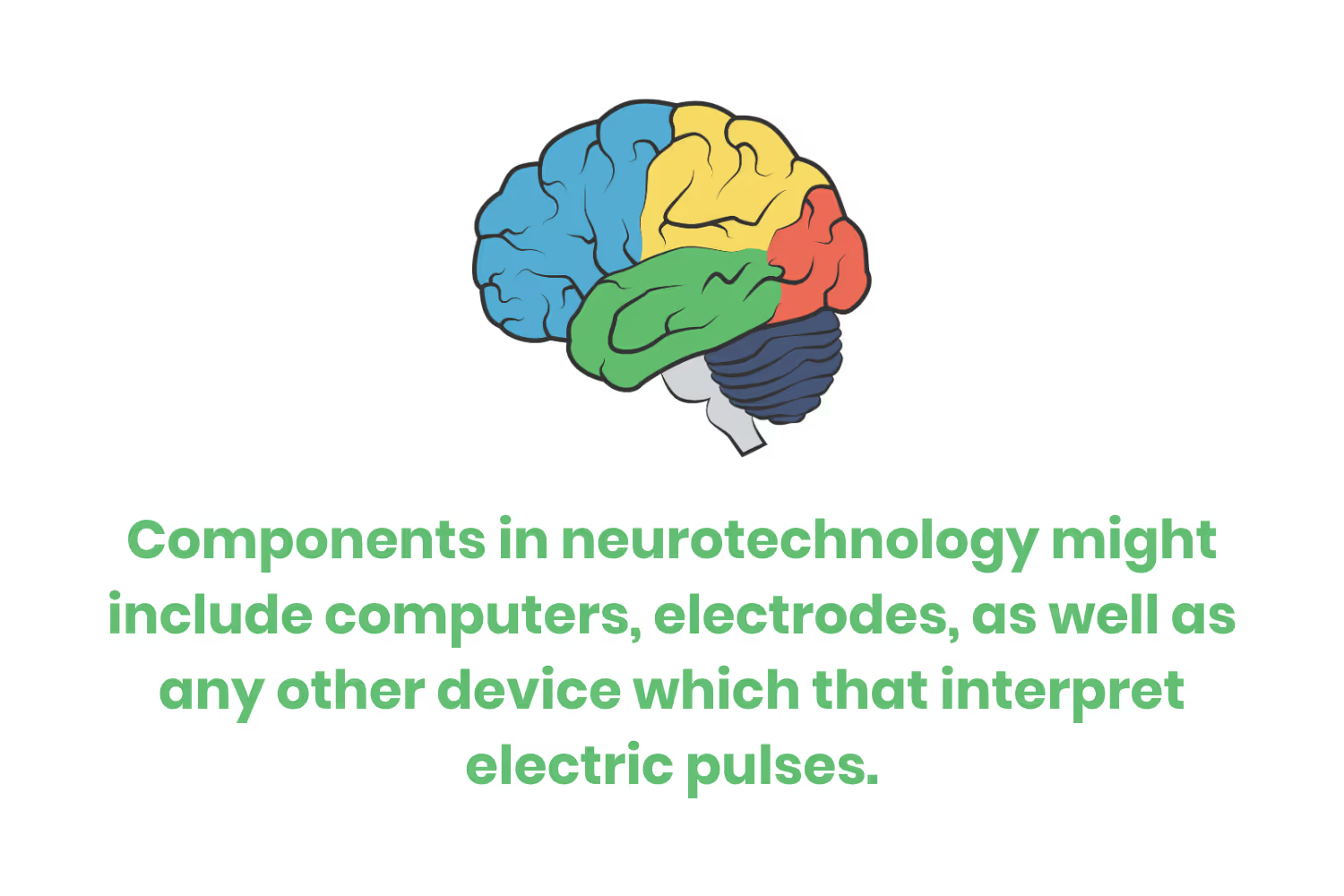
Components in neurotechnology might include computers, electrodes, as well as any other device which that interpret electric pulses. Neurotechnology is currently used for processes such as:
- Brain imaging: Records magnetic fields. Produced by the brain’s electrical activity.
- Neurostimulation: Stimulating the brain and nervous system, thus influencing brain activity.
- Neuro-devices: Used to monitor brain activity, as well as regulate it, by using an implant.
7. Organs-on-Chips
This next technology has a bit of a ring to it: organ-on-a-chip. No, it’s not a dish you can order at some eccentric fancy restaurant, which is personally what I think it sounds like. Nope, this is something called a microfluidic device. This device stimulates the functions of human organs, which aids in drug testing among other things.
To mimic human organs and maintain tissue-specific functions, these devices can control microenvironments. This device contains networks of microchannels that guide and manipulate minute volumes. The miniature tissue grows and resides in the microfluidic chip, replicating one or more specific functions. These of course are not as complicated as biological organs but can mimic human physiology and disease.
8. Virtual Reality (VR) in Healthcare
Virtual reality (VR) isn’t just for video games. Patient education and exposure therapy are just two of the many ways providers are utilizing this technology. Mental health professionals enjoy this advancement in MedTech.
It allows for alternative ways to help patients manage stress and anxiety. However, benefits are not limited to only mental health issues. Medical professionals are also able to learn through VR, allowing them to train in realistic scenarios.

9. Cryonics
Some scientists propose that aging is a disease, and so therefore there must be a treatment for it. Cryonics is an experimental technology that aims to preserve organisms at low (cryogenic) temperatures. The hope is that we can then revive these individuals in the future once advanced medical technology is available. Think about the show Futurama, which is a perfect example of how cryonics theoretically should work.
Scientists can only perform cryonics after the pronunciation of legal death in an individual. The scientific justification for this technology rests on the following concepts:
- Low temperature slows metabolism. The right low temperature can stop chemical changes for centuries.
- We can reduce ice formation with the use of vitrification mixtures.
- Legally dead does not necessarily mean irreversibly dead”. Death is a process, not an event.
- Theoretically, damage from low temperature and clinical death that is not reversible today, could be reversible in the future.
Although this is not yet a recognized medical procedure, science continues to make advancements.
10. Next-Generation Vaccines
Next-generation vaccines are next on our list of new and improved medical technology examples. This technology offers rapid responses to infectious diseases through new platforms, such as mRNA vaccines.
mRNA’s potential is not just exciting when it comes to responding to viruses. This process can code for just about any protein. Meaning that the technology used to create vaccinations for viruses can also create treatments for different kinds of diseases. These next-generation vaccines are more than capable of cutting production costs. By allowing the human body to work on manufacturing proteins on its own.
11. Technology in Mental Health
The World Health Organization estimates that depression will be the leading cause of disease burden on a global level by 2030. Disease burden is the impact of a health problem measured as financial loss, mortality, and other indicators. However, new technologies are on the horizon which will help patients address their ongoing mental health needs.
Digital and online symptom tracking encourages patients to share data daily. This makes for more efficient mental health care. Many patients have difficulty recalling moments where they felt anxious or depressed while in therapy, as well as why or what caused it. This is especially true if patients are only able to see their therapists once a month. I can barely remember what I ate for breakfast this morning. Providers can then check the data to help spike their memory. They can also check in on their patients, even when they are not in a session, and intervene if there are any warning signs.
The use of video games is another technology now used in the mental health space. EndeavorRX is an FDA-authorized video game treatment. Approved in 2020, this game helps to improve the attention span of children with ADHD. Interestingly enough, 73% of children reported an improvement in their attention span after playing the game.
Conclusion
With the evolution of medical technology, it is important to keep up with the latest news and updates. Looking ahead to 2024 and beyond, the future of innovation and healthcare looks promising.
While there are ethical considerations and more research needed for much of this technology, there are also plenty of opportunities to explore. Together, we shape the trajectory of medical technology for a brighter and healthier future.
Emphasize your product's unique features or benefits to differentiate it from competitors
In nec dictum adipiscing pharetra enim etiam scelerisque dolor purus ipsum egestas cursus vulputate arcu egestas ut eu sed mollis consectetur mattis pharetra curabitur et maecenas in mattis fames consectetur ipsum quis risus mauris aliquam ornare nisl purus at ipsum nulla accumsan consectetur vestibulum suspendisse aliquam condimentum scelerisque lacinia pellentesque vestibulum condimentum turpis ligula pharetra dictum sapien facilisis sapien at sagittis et cursus congue.
- Pharetra curabitur et maecenas in mattis fames consectetur ipsum quis risus.
- Justo urna nisi auctor consequat consectetur dolor lectus blandit.
- Eget egestas volutpat lacinia vestibulum vitae mattis hendrerit.
- Ornare elit odio tellus orci bibendum dictum id sem congue enim amet diam.
Incorporate statistics or specific numbers to highlight the effectiveness or popularity of your offering
Convallis pellentesque ullamcorper sapien sed tristique fermentum proin amet quam tincidunt feugiat vitae neque quisque odio ut pellentesque ac mauris eget lectus. Pretium arcu turpis lacus sapien sit at eu sapien duis magna nunc nibh nam non ut nibh ultrices ultrices elementum egestas enim nisl sed cursus pellentesque sit dignissim enim euismod sit et convallis sed pelis viverra quam at nisl sit pharetra enim nisl nec vestibulum posuere in volutpat sed blandit neque risus.
Use time-sensitive language to encourage immediate action, such as "Limited Time Offer
Feugiat vitae neque quisque odio ut pellentesque ac mauris eget lectus. Pretium arcu turpis lacus sapien sit at eu sapien duis magna nunc nibh nam non ut nibh ultrices ultrices elementum egestas enim nisl sed cursus pellentesque sit dignissim enim euismod sit et convallis sed pelis viverra quam at nisl sit pharetra enim nisl nec vestibulum posuere in volutpat sed blandit neque risus.
- Pharetra curabitur et maecenas in mattis fames consectetur ipsum quis risus.
- Justo urna nisi auctor consequat consectetur dolor lectus blandit.
- Eget egestas volutpat lacinia vestibulum vitae mattis hendrerit.
- Ornare elit odio tellus orci bibendum dictum id sem congue enim amet diam.
Address customer pain points directly by showing how your product solves their problems
Feugiat vitae neque quisque odio ut pellentesque ac mauris eget lectus. Pretium arcu turpis lacus sapien sit at eu sapien duis magna nunc nibh nam non ut nibh ultrices ultrices elementum egestas enim nisl sed cursus pellentesque sit dignissim enim euismod sit et convallis sed pelis viverra quam at nisl sit pharetra enim nisl nec vestibulum posuere in volutpat sed blandit neque risus.
Vel etiam vel amet aenean eget in habitasse nunc duis tellus sem turpis risus aliquam ac volutpat tellus eu faucibus ullamcorper.
Tailor titles to your ideal customer segment using phrases like "Designed for Busy Professionals
Sed pretium id nibh id sit felis vitae volutpat volutpat adipiscing at sodales neque lectus mi phasellus commodo at elit suspendisse ornare faucibus lectus purus viverra in nec aliquet commodo et sed sed nisi tempor mi pellentesque arcu viverra pretium duis enim vulputate dignissim etiam ultrices vitae neque urna proin nibh diam turpis augue lacus.