
Insurance Downcoding: Combatting Policies and AI
Learn how insurance downcoding and AI-driven payer policies impact medical billing, and discover strategies to prevent revenue loss and protect reimbursement.

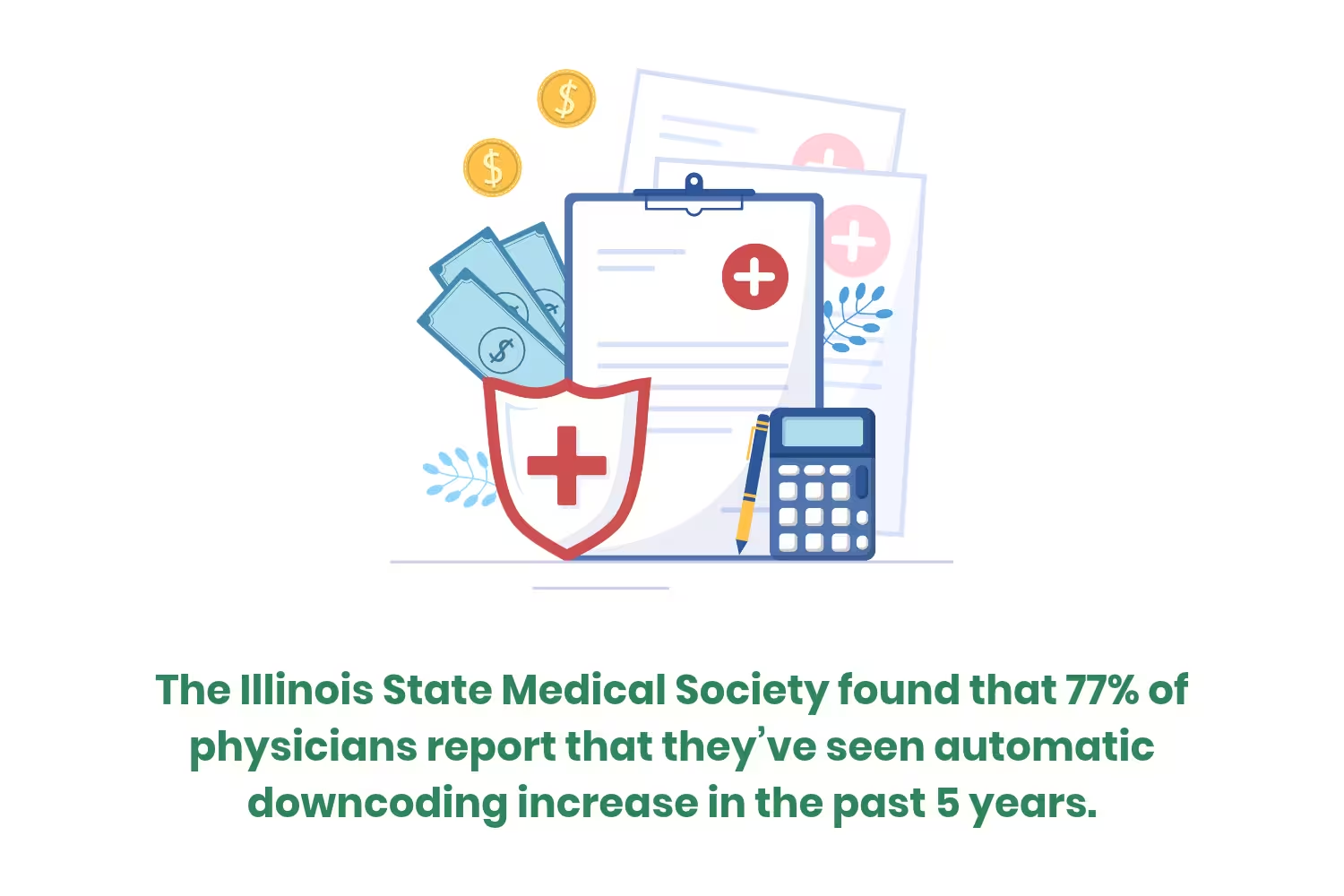
The Illinois State Medical Society found that 77% of physicians report that they’ve seen automatic downcoding increase in the past 5 years. This isn't just an Illinois problem, either. Nationwide, providers have been dealing with an uptick in downcoding in their medical billing process. So what gives?
Payers are leaning on automated tools more than ever. Some use claims data and algorithms to cut E/M codes without ever reading the medical record. Big insurers like Cigna and Aetna have been part of that shift. For practices, especially primary care, the result is less revenue and extra administrative burden.
In this post, we break down what downcoding is, why payers use it, and how AI is changing the process. Then we will cover practical ways to protect your revenue cycle and push for fair reimbursement. Let's get into it!
What Is Downcoding in Medical Billing?
Downcoding is the process of reducing a billing code to a lower level after submission. The result is a lower reimbursement amount for the healthcare provider.
A downcode in medical billing occurs after a payer reviews your claim. They decide the evaluation and management (E/M) code doesn’t meet their reimbursement criteria. Then they change the code.
Here is a simple example. A provider submits a bill using CPT code 99214. The insurer reduces it to 99213. That lower-level code represents a different level of service. Therefore, a different reimbursement amount.
The submitted code should reflect what the medical record shows. That includes the complexity of the encounter and the work performed.
However, not every change is inappropriate. A payer may have a legitimate reason to reduce a code when documentation doesn’t support it. Payer downcoding becomes a concern when adjustments don’t account for the care provided.
Understanding Upcoding and Downcoding in Medical Billing
If you were wondering, upcoding and downcoding are not the same thing. Here are the main differences:
- Upcoding occurs when a provider bills for a higher-level service than the documentation supports.
- Downcoding occurs when a submitted code reduces to a lower code.
Both can create reimbursement and compliance concerns. But they carry different implications for providers and payers.
Why Are Payers Implementing Downcoding Policies?
Insurance companies need to review submitted claims for several reasons. They want to check coding accuracy, spot billing inconsistencies, and manage reimbursement.
Payer existing policies set the criteria. This criteria decides whether a billing code meets the insurer’s requirements. Or if it constitutes a denial.
Some health plans use claims data, historical billing patterns, and automated review processes. These tools flag certain E/M codes for extra scrutiny.
However, automatic downcoding is a growing concern for medical practices. Some payer downcoding programs skip the full clinical documentation. They use only the information on the claim to decide whether a code should be reduced.
That creates real challenges for healthcare providers. Diagnosis codes and claim-level data often don’t show the full complexity of an encounter.
There is a difference between appropriate coding oversight and frequent downcoding. Oversight checks accuracy. Frequent downcoding may ignore the clinical documentation entirely.
Providers and payers both want accurate medical coding. But reimbursement decisions should reflect applicable coding guidelines. They should also reflect the services actually delivered.
How AI Is Changing Payer Downcoding in Medical Billing
AI and automated claims review tools are changing how payers evaluate claims.
Algorithms can analyze huge volumes of claims data. They can spot billing patterns, unusual utilization, and possible coding discrepancies.
Automatic downcoding can happen when a system flags a high-level E/M code. The flag is based on payer-defined criteria.
This approach has limits. A system that doesn’t review the complete medical record sees only part of the picture. A diagnosis code alone may not show the full extent of a patient’s condition. It may not show treatment decisions or provider workload either.
Medical decision-making and total time determine the appropriate E/M code. Both matter when deciding whether they support a higher-level service. Neither can be judged from a diagnosis code alone.
There is a clear risk here. An algorithm may assign a lower code without considering the chronic conditions. It may also miss treatment complexity or other circumstances documented during the encounter.
AI-assisted reviews can also increase scrutiny of provider billing practices. This is especially true when automated systems find patterns that differ from payer expectations.
AI is not only a challenge, though. It can also help providers. It can catch coding errors, improve documentation accuracy, and track reimbursement trends.
What Are the Risks of Downcoding for Primary Care Practices?
The risks of downcoding go beyond one reduced payment. Primary care practices feel the impact most. They manage patients with complex, ongoing needs.
Family physicians often handle a lot in one visit. They may address multiple chronic conditions. They coordinate specialist care. They evaluate symptoms and manage treatment plans. The AAFP also points to behavioral health and social drivers of health.
A diagnosis code may not capture all that work. A patient with several medical concerns takes more effort than one code can show.
Frequent downcoding has real costs:
- Lower reimbursement for services documented and coded correctly.
- More administrative work. Staff must investigate adjustments, retrieve records, submit appeals, and follow up with payers.
- Strain on small practices. Independent practices often have fewer administrative resources for repeated disputes.
- Undercoding. Providers may start billing complex encounters at lower levels to avoid scrutiny. That leads to inaccurate reporting of the care provided.
These issues reach other specialties too. Behavioral health is one example. Patient complexity and treatment decisions may not show up in diagnosis codes alone.
How to Combat Downcoding and Protect Your Revenue Cycle
Strengthen Clinical Documentation
Strong documentation is your first defense. Start by making sure each medical record reflects the services provided. Document the reasoning behind clinical decisions, including medical decision-making. Include the patient’s conditions, data reviewed, treatment risks, and management plans.
Time matters too. Record total time when using time-based E/M coding. Avoid generic or repetitive notes that don’t capture the individual encounter. Then confirm that your documentation supports the billing code and level of service.
Conduct Regular Coding Audits
Audits show where problems start. MGMA recommends regular internal and external audits. This is especially true for providers who see frequent downcoding or denials.
Begin by scheduling internal and external reviews of coding accuracy. Compare submitted E/M codes with the clinical documentation. Look for recurring coding errors across providers. Pay close attention to high-level E/M codes. Confirm that the documentation supports the reported complexity.
Then put the findings to work. Use them to educate physicians and each medical coder. Also, follow coding guidelines and payer-specific requirements consistently.
Monitor Payer Reimbursement Patterns
You can’t fix what you don’t track. Start by comparing the original code with the code the payer reimbursed.
Next, review EOBs and remittance advice for adjustments. Look for references to payer policy or service-level changes. Track downcoded claims by payer, provider, CPT code, and date of service. This makes patterns easier to see. Those patterns may point to a broader payer issue.
Keep an eye on how often denials and partial-payment adjustments occur. Track reimbursement discrepancies and recovered revenue as well. Reporting tools can show which insurance companies cause the most adjustments.
MGMA also recommends tracking affected codes, providers, appeal activity, and appeal success rates. This helps practices respond to automated downcoding.
Establish a Consistent Appeals Process
A standard process saves time. It also improves your odds.
Build a standardized billing process for challenging inappropriate adjustments. Start each appeal by reviewing the payer’s explanation for the downcoded claim. Then gather the original medical record and supporting documentation. Reference applicable coding guidelines and relevant payer policies. Submit everything within the insurer’s appeal deadline.
Afterward, track outcomes. This shows which adjustments are most likely to overturn. If the same issue keeps coming up, escalate it. Send it to payer representatives or a medical association.
One point matters most. A strong appeal shows why the original code accurately reflects the encounter. It does not simply argue that the provider deserves more money.
Use AI and Automation to Identify Revenue Leakage
Practices can fight automation with automation. MGMA makes a strong case for using AI to find issues created by payer AI.
AI-assisted coding and billing tools can find documentation gaps before claims go out. Automated reporting can flag unusual reimbursement changes and recurring payer adjustments.
Billing teams can also compare submitted codes with actual payments faster. AI-assisted auditing can catch potential coding errors and improve claim accuracy. With less manual work, teams gain better visibility into the revenue cycle.
Keep one rule in mind. Technology should support qualified medical coders and billing professionals. It should never replace clinical judgment.
How Medical Practices Can Advocate for Fair Payer Reimbursement
Providers and payers need clear communication. They also need consistent expectations about reimbursement decisions.
The AMA and other physician organizations are pushing for more transparency in automated reimbursement decisions. The AAFP and its peers also call for three things:
- Advance notice of downcoding programs.
- Meaningful explanations for adjustments.
- Simpler appeals processes.
Practices can take part in several ways:
- Ask for a clear explanation whenever an insurer reduces a submitted code.
- Stay informed about changing downcoding policies. Also, how they affect different health insurance plans.
- Push for notice when a provider is an outlier or faces extra claims scrutiny.
- Work with professional organizations to raise concerns about inappropriate adjustments. This applies to health systems and independent practices alike.
Protecting patient care is the larger goal. Reimbursement disputes shouldn’t pull time and resources away from clinical work.
Greater transparency also helps both sides. It sets consistent expectations for accurate coding and appropriate reimbursement.
Protect Your Revenue Cycle From Inappropriate Payer Downcoding
Downcoding is a growing challenge for coders. Accurate medical coding, complete documentation, and steady reimbursement monitoring are your best protection. Together, they keep your practice financially healthy.
Spotting downcoding trends early matters. It helps you stop revenue leakage before it becomes a bigger problem. Clean claims take more than accurate submissions. Practices also need to see how payers process and pay those claims.
Reliable billing services, reporting tools, and proactive claims management can cut unnecessary work. They also help you balance accurate coding with fair payment. That way, your reimbursement reflects the care you provide.
Ready to take control of your claims? Etactics helps practices gain clearer visibility into their revenue cycle. Contact us today to see how we can help you protect your revenue.
Emphasize your product's unique features or benefits to differentiate it from competitors
In nec dictum adipiscing pharetra enim etiam scelerisque dolor purus ipsum egestas cursus vulputate arcu egestas ut eu sed mollis consectetur mattis pharetra curabitur et maecenas in mattis fames consectetur ipsum quis risus mauris aliquam ornare nisl purus at ipsum nulla accumsan consectetur vestibulum suspendisse aliquam condimentum scelerisque lacinia pellentesque vestibulum condimentum turpis ligula pharetra dictum sapien facilisis sapien at sagittis et cursus congue.
- Pharetra curabitur et maecenas in mattis fames consectetur ipsum quis risus.
- Justo urna nisi auctor consequat consectetur dolor lectus blandit.
- Eget egestas volutpat lacinia vestibulum vitae mattis hendrerit.
- Ornare elit odio tellus orci bibendum dictum id sem congue enim amet diam.
Incorporate statistics or specific numbers to highlight the effectiveness or popularity of your offering
Convallis pellentesque ullamcorper sapien sed tristique fermentum proin amet quam tincidunt feugiat vitae neque quisque odio ut pellentesque ac mauris eget lectus. Pretium arcu turpis lacus sapien sit at eu sapien duis magna nunc nibh nam non ut nibh ultrices ultrices elementum egestas enim nisl sed cursus pellentesque sit dignissim enim euismod sit et convallis sed pelis viverra quam at nisl sit pharetra enim nisl nec vestibulum posuere in volutpat sed blandit neque risus.
Use time-sensitive language to encourage immediate action, such as "Limited Time Offer
Feugiat vitae neque quisque odio ut pellentesque ac mauris eget lectus. Pretium arcu turpis lacus sapien sit at eu sapien duis magna nunc nibh nam non ut nibh ultrices ultrices elementum egestas enim nisl sed cursus pellentesque sit dignissim enim euismod sit et convallis sed pelis viverra quam at nisl sit pharetra enim nisl nec vestibulum posuere in volutpat sed blandit neque risus.
- Pharetra curabitur et maecenas in mattis fames consectetur ipsum quis risus.
- Justo urna nisi auctor consequat consectetur dolor lectus blandit.
- Eget egestas volutpat lacinia vestibulum vitae mattis hendrerit.
- Ornare elit odio tellus orci bibendum dictum id sem congue enim amet diam.
Address customer pain points directly by showing how your product solves their problems
Feugiat vitae neque quisque odio ut pellentesque ac mauris eget lectus. Pretium arcu turpis lacus sapien sit at eu sapien duis magna nunc nibh nam non ut nibh ultrices ultrices elementum egestas enim nisl sed cursus pellentesque sit dignissim enim euismod sit et convallis sed pelis viverra quam at nisl sit pharetra enim nisl nec vestibulum posuere in volutpat sed blandit neque risus.
Vel etiam vel amet aenean eget in habitasse nunc duis tellus sem turpis risus aliquam ac volutpat tellus eu faucibus ullamcorper.
Tailor titles to your ideal customer segment using phrases like "Designed for Busy Professionals
Sed pretium id nibh id sit felis vitae volutpat volutpat adipiscing at sodales neque lectus mi phasellus commodo at elit suspendisse ornare faucibus lectus purus viverra in nec aliquet commodo et sed sed nisi tempor mi pellentesque arcu viverra pretium duis enim vulputate dignissim etiam ultrices vitae neque urna proin nibh diam turpis augue lacus.