
Medical Coding Career: Dying or Thriving?
Many medical coders find themselves wondering, “Am I working in a dying career?” The short answer to that question is no. But I’ll answer that question the long way for the rest of this blog post.

The U.S. Bureau of Labor Statistics projects medical records specialist jobs, including medical coding roles, will grow 7% between 2024 and 2034, faster than the average occupation in the United States. So why are so many people convinced AI is replacing medical coders?
We’ve all heard the argument before: at a certain point, technology makes a job so efficient that many of its original responsibilities become automated. Over time, that efficiency can reduce the need for as many full-time employees performing repetitive tasks.
That’s where much of the fear around AI comes from.
There are thousands of articles discussing how artificial intelligence (AI) and robotics will soon replace millions of jobs across healthcare and beyond. You’ve probably seen those headlines too.
The reality is that these narratives are often designed to capture attention, not accurately predict workforce collapse. There won’t be a sudden wave of unemployment wiping out every coding or billing role overnight.
In fact, it’s estimated that 85% of the jobs in 2030 don’t exist yet, according to The Institute for the Future (IFTF).
Even with that in mind, it’s understandable why medical coders, billers, and other healthcare professionals might still worry about whether their careers are being impacted by technology.
One of the careers most often discussed in this context is medical coding. Many professionals naturally ask: “Am I working in a dying career?”
The short answer is no.
Medical coding is still a strong career in 2026, especially for professionals willing to adapt, specialize, and continue learning as artificial intelligence tools become more integrated into healthcare organizations.
But I’ll answer that question in more detail for the rest of this blog post.
Don't Panic: What's Changing
There’s no way to ignore the upcoming changes to medical coding brought forth by technology and AI.
Here’s the reality.
A lot of tasks associated with medical coding are similar to recognizing people within photos. What I mean by that is it’s a set of unstructured data that requires labeling. Fancy AI people call this pattern recognition supervised learning and it’s achievable through current technology.
If you’re familiar with many of the tasks a medical coder performs today, you’ll understand the significance of this comparison. A lot of what’s done in this coding career on a daily basis fits this type of rapid decision-making and structured interpretation.
What does this mean?
First, it means there’s a lot of money on the table for the technology company that comes up with an AI solution that helps coders perform their job faster and better. As time passes and the solution becomes more advanced, it’ll take on more tasks. Eventually, over the course of a few decades or so, automation will take over the majority of repetitive medical coding and medical billing tasks.
That sounds intimidating, especially for entry-level coders entering the medical field.
So, if you come across someone who’s deciding whether or not they should pursue medical billing and coding, what do you say? After all, just a few paragraphs earlier I told you that it’s not a dying career.
I haven’t changed my mind.
Medical coding is not a dying career.
Yes, over time certain jobs have disappeared due to technological advancements. But there’s a pattern with all of these. The majority of them are low-skill, technology-dependent careers.
Medical coding is different.
It requires a mixture of human analytical skills, communication, analytics, compliance knowledge, and healthcare experience with or without technology. A detail-oriented medical coder still provides value that AI systems struggle to replicate consistently.
Current and future coders should embrace the technological advancements headed their way. The experts within the field shouldn’t have to spend hours each day working simple charts or reviewing repetitive medical record documentation manually.
Similarly, those just starting out in a coding program or certification program should get feedback on simple mistakes in real time so they can improve faster.
AI should enhance the work of healthcare professionals, not eliminate them entirely.
Shifts in Responsibility
Current medical coders are experiencing shifts in their responsibilities.
They’re becoming more exclusive.
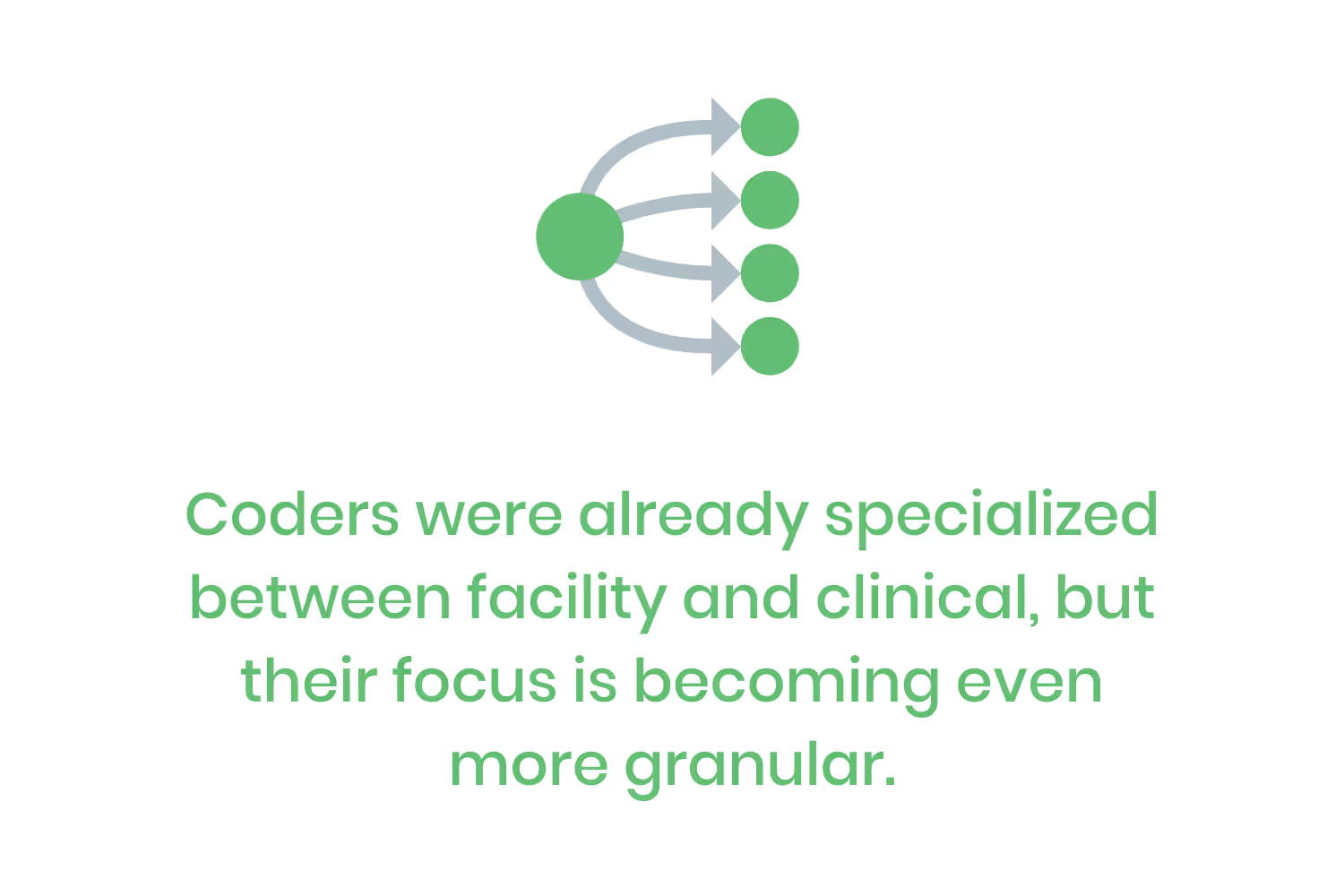
They were already specialized between facility and clinical, but their focus is becoming even more granular.
Ambulatory Surgery Centers (ASC) are actively pursuing individuals who specialize orthopedics, gastroenterology, OB/GYN, cardiology, and neurology coding. The demand for coding specialists is so high right now that it’s one of the main reasons there’s continued growth for this healthcare career.
Healthcare employers increasingly want coders with a CPC credential, CCA credential, coding certificate, and advanced certification.
This is why earning a medical coding certification or completing certification programs through organizations like AAPC can significantly improve career advancement opportunities and long-term earning potential.
The job outlook for medical coding remains strong because the healthcare system continues to expand while the aging population requires additional medical care and more detailed documentation.
Furthermore, the skills that medical coders develop over the course of their career are translatable into other healthcare information technology (IT) areas.
Here’s an example, coders work with protected health information (PHI) in order to accurately communicate with insurance companies. Working with PHI means they need to fully understand and remain compliant with the Health Insurance Portability and Accountability Act (HIPAA).
This means coders have advanced, first-hand knowledge of how one of the most encompassing laws in healthcare works. Thus, they could easily pivot toward positions involving compliance, audit responsibilities, health information management, revenue integrity, or revenue cycle operations within a healthcare organization.
Another example of how translatable medical coders skills involves denial management. Insurance claim denials cost hospitals and practices around $262 billion per year. That’s a ton of money left on the table. So how can a coder help in this process?
Well, as I just mentioned, coders have access to the complete medical record. These records include details about the entire patient encounter. Denial management is an aspect of the revenue cycle that starts at the time of registration, continues through discharge, and completes during collection.
In other words, it lines up perfectly with the information coders have access to.
This means coders, medical billers, reimbursement specialists, and auditors are in a unique position to identify areas of improvement that help prevent and reduce denials.
Why Medical Coders are Still Needed
Although essentially everything that can happen to a patient has a definable ICD code, there’s still a lot of grey areas within this field.
A few years ago, a professional coder hosted an “Ask Me Anything” (AMA) session on Reddit. The user said that their secret to success within this field is understanding that no everything is black and white. They went on to say, “The adage is that if you ask 5 different coders to code a procedure or [evaluation and management] then you'll get 5 different answers with detailed explanations from each coder on why they're right.”
How is technology going to solve that issue if…
- Rules are contradictory
- Descriptions are vague
- Instructions use soft language
It would take an advanced AI system to determine the best answer to a problem if almost everything medical coding related allows for multiple interpretations. Thus, this field is more of an art than a science.
Every interaction between a provider and their patient is unique, regardless if there are similarities that happened with another client.
Furthermore, policies, CPT rules, ICD updates, and governmental regulations change constantly.
In 2019, the American Medical Association (AMA) and UnitedHealthcare (UH) developed 23 new social determinant medical codes. These codes allow for specific identification of social needs and risk factors for patients. They’re an add-on to the preexisting z-codes introduced in 2015 but provide better incentives because they tie into reimbursement.
Z-codes weren’t widely used by coders up until this point.
Instead, case managers, discharge planners, social workers and nurses used social determinants most often. But, the new codes work with payment calculations and risk-adjustments for providers. This incentivizes healthcare organizations to use them.
That’s a semi-complicated answer to further prove that policies and regulations change so often and so specifically that it’s nearly impossible for anything but a medical coder to figure out how to navigate them.
Ever-Changing ICD 11 and CPT Codes
ICD 11 is Here
As time passes, we have a better understanding of human health and human psychology.
This also means that ICD codes need updates regularly, with new chapters, new terms, and more in-depth codes.
Since January 1, 2022 healthcare organizations must refer to ICD-11. The new version contains 6 new chapters and 55,000 unique disease classification codes.
Some examples of these changes relate to immune system diseases, traditional medicine, and developmental anomalies. These codes also have a better representation of cancers, addictions, medications, substances, and causes of injuries.
The fact that the new version includes so many additional classification codes is daunting for most organizations. Yet, it’s good news for medical coders. Each healthcare facility will need a team of devoted experts to sift through and properly classify the thousands of treatments and procedures.
This expands opportunities for coders who specialize in highly technical specialties.
It also reinforces why ongoing education and continuing certification are necessary for anyone serious about long-term job security in this field.
Off The Cuff CPT Codes
Medical coders are also responsible for applying Current Procedural Terminology (CPT) codes.
On January 1, 2025, the American Medical Association introduced and enforced 420 CPT code changes, including:
- 270 new codes
- 112 deletions
- 38 revisions
Many of these updates focused on artificial intelligence, remote patient monitoring, digital medicine, and emerging healthcare technologies.
As healthcare continues evolving, CPT codes must constantly adapt to new procedures, treatments, and documentation requirements.
The increased use of telehealth services, digital consultations, and technology-driven medical care has also created additional complexity for healthcare providers and coding specialists alike.
The only way the industry can continue to function as new CPT code updates occur on the fly is by having a pool of experienced medical coders to support the effort.
Outsourcing is Increasing
More diagnosis and procedural codes make healthcare processes more complex, making it harder for facilities to focus on their patients (no wonder doctors are so burnt out). Yet, no practice is immune to the mandated changes that happen on a yearly basis.
As a result, outsourcing medical billing processes to a third-party organization is a massive trend.
In fact, that subsect of medical billing will reach $23.1 billion by 2027 according to Global View Research, Inc.
According to their research, medical coding outsourcing will eclipse in-house teams by 2021. From there it continues to skyrocket in popularity.
Although it costs healthcare facilities money to outsource, it saves them time. That way, they won’t have to focus on their backend processes and can place all of their efforts on caring for their patients.
This trend also creates new opportunities for remote work and remote positions.
Many employers now hire remote medical coders with CPC certification, CCA credentials, or advanced coding certification experience.
For professionals looking for flexibility, medical coding remains one of the better work-from-home opportunities in the healthcare field.
That flexibility is a major perk for professionals balancing family responsibilities, job hunting, or continuing education goals.
How to Stay Competitive as a Medical Coder
The future of medical coding doesn’t belong to professionals who resist technology.
It belongs to coders who adapt.
That means:
- Pursuing a medical coding certification
- Completing a coding certificate program
- Continuing ongoing education
- Earning a CPC, CCA, or CC credential
- Staying compliant with changing regulations
- Learning denial management strategies
- Understanding reimbursement systems
- Expanding into audit and auditor roles
- Developing stronger analytical skills
- Improving attention to detail
- Learning how AI tools support workflow efficiency
- Understanding health insurance requirements
- Exploring health information management opportunities
The coders who continue learning and get certified will continue finding opportunities for career advancement.
Even as technology evolves, the healthcare system still depends on experienced coding specialists to maintain accuracy, compliance, and revenue integrity.
Medical coders remain part of the backbone of modern healthcare operations.
Conclusion
A lot of jobs you see today won’t exist anymore within the next few years.
Either they’re dependent on outdated business models or their responsibilities are simple enough that they’ll eventually get replaced by technology.
Medical coding isn’t a career that falls into that category, though.
That doesn’t mean it’s impervious to change.
Technology and artificial intelligence are already affecting this field and making tedious tasks easier than ever. But, as I mentioned before, there are certain aspects of the job that are still decades away from being fully automated without human intervention.
Medical coding, medical billing, compliance, denial management, health information management, and revenue cycle processes still require trained professionals capable of understanding nuance, documentation quality, reimbursement rules, insurance claims, and patient-specific situations.
The industry may evolve, but it’s far from becoming oversaturated or obsolete.
In fact, the increasing complexity of healthcare, combined with a growing aging population, means experienced coders will remain in high demand for years to come.
If you know someone considering getting into medical billing and coding, or if that person is yourself, make sure to reiterate that medical coding is not a dying career.
Emphasize your product's unique features or benefits to differentiate it from competitors
In nec dictum adipiscing pharetra enim etiam scelerisque dolor purus ipsum egestas cursus vulputate arcu egestas ut eu sed mollis consectetur mattis pharetra curabitur et maecenas in mattis fames consectetur ipsum quis risus mauris aliquam ornare nisl purus at ipsum nulla accumsan consectetur vestibulum suspendisse aliquam condimentum scelerisque lacinia pellentesque vestibulum condimentum turpis ligula pharetra dictum sapien facilisis sapien at sagittis et cursus congue.
- Pharetra curabitur et maecenas in mattis fames consectetur ipsum quis risus.
- Justo urna nisi auctor consequat consectetur dolor lectus blandit.
- Eget egestas volutpat lacinia vestibulum vitae mattis hendrerit.
- Ornare elit odio tellus orci bibendum dictum id sem congue enim amet diam.
Incorporate statistics or specific numbers to highlight the effectiveness or popularity of your offering
Convallis pellentesque ullamcorper sapien sed tristique fermentum proin amet quam tincidunt feugiat vitae neque quisque odio ut pellentesque ac mauris eget lectus. Pretium arcu turpis lacus sapien sit at eu sapien duis magna nunc nibh nam non ut nibh ultrices ultrices elementum egestas enim nisl sed cursus pellentesque sit dignissim enim euismod sit et convallis sed pelis viverra quam at nisl sit pharetra enim nisl nec vestibulum posuere in volutpat sed blandit neque risus.
Use time-sensitive language to encourage immediate action, such as "Limited Time Offer
Feugiat vitae neque quisque odio ut pellentesque ac mauris eget lectus. Pretium arcu turpis lacus sapien sit at eu sapien duis magna nunc nibh nam non ut nibh ultrices ultrices elementum egestas enim nisl sed cursus pellentesque sit dignissim enim euismod sit et convallis sed pelis viverra quam at nisl sit pharetra enim nisl nec vestibulum posuere in volutpat sed blandit neque risus.
- Pharetra curabitur et maecenas in mattis fames consectetur ipsum quis risus.
- Justo urna nisi auctor consequat consectetur dolor lectus blandit.
- Eget egestas volutpat lacinia vestibulum vitae mattis hendrerit.
- Ornare elit odio tellus orci bibendum dictum id sem congue enim amet diam.
Address customer pain points directly by showing how your product solves their problems
Feugiat vitae neque quisque odio ut pellentesque ac mauris eget lectus. Pretium arcu turpis lacus sapien sit at eu sapien duis magna nunc nibh nam non ut nibh ultrices ultrices elementum egestas enim nisl sed cursus pellentesque sit dignissim enim euismod sit et convallis sed pelis viverra quam at nisl sit pharetra enim nisl nec vestibulum posuere in volutpat sed blandit neque risus.
Vel etiam vel amet aenean eget in habitasse nunc duis tellus sem turpis risus aliquam ac volutpat tellus eu faucibus ullamcorper.
Tailor titles to your ideal customer segment using phrases like "Designed for Busy Professionals
Sed pretium id nibh id sit felis vitae volutpat volutpat adipiscing at sodales neque lectus mi phasellus commodo at elit suspendisse ornare faucibus lectus purus viverra in nec aliquet commodo et sed sed nisi tempor mi pellentesque arcu viverra pretium duis enim vulputate dignissim etiam ultrices vitae neque urna proin nibh diam turpis augue lacus.